

How we all turned Google into our monopolist
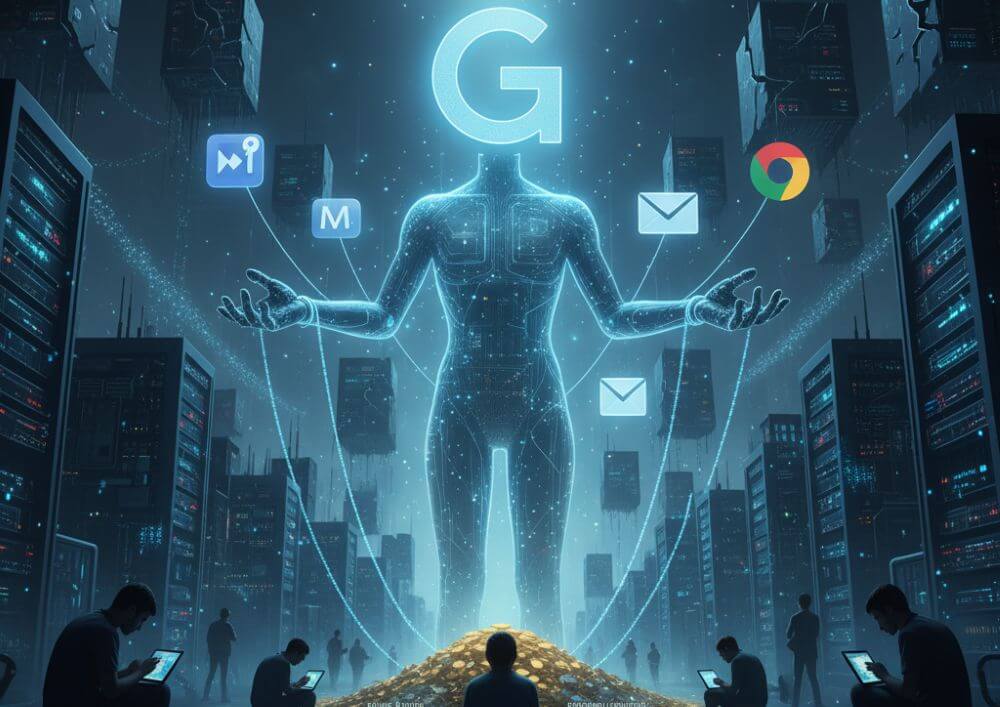
One thought, one click, one answer. In seconds. When we „search“ today, we mean „Google.“ The word has become a verb, a synonym for knowledge, a global reflex action. But this ultimate triumph of technology is no accident. It is the result of a tacit pact we have all made. Google didn’t simply become a monopolist—we made it so.
We complain about the omnipotence of a corporation that knows more about us than our closest confidants. We fear the lack of alternatives and the transparent citizen. But the uncomfortable truth is: Google didn’t conquer us. We surrendered willingly.
We created this digital god by readily sacrificing what it needed to grow: our convenience, our data, and our lack of competition.

The original sin: We chose the better product
To understand how we got here, we have to go back to the late 1990s. The internet was a chaotic, unstructured place. Search engines like AltaVista, Lycos, and Yahoo delivered unsatisfactory, often irrelevant results, cluttered with flashing banners.
Then came Google!
With a minimalist white page and an algorithm (PageRank) that seemingly magically delivered what we were really looking for. It was fast, it was clean, it was thousands of times better than anything else.
Our first step toward creating the monopoly wasn’t a mistake, but a logical decision. We chose the superior product. We flocked to Google because it worked. And we never looked back.
The convenience trap: „Free“ as bait
Our fall from grace was the greed for something better. But our continued existence was bought with „freebies.“ Google wasn’t just better, it was free. And it didn’t stop at search.
Google understood faster than anyone else that the future lay not in selling software, but in building an indispensable ecosystem. And we happily stumbled into it:
- Gmail (2004): Why pay for emails or struggle with tiny mailboxes? Google offered one gigabyte (!) of free storage. A shocking offer. We handed them over all our private and business communications.
- Google Maps (2005): Street maps became obsolete. We received a free, all-knowing world map and a navigation system in our pocket. In return, we gave Google our exact location, every step we took, every destination.
- YouTube (2006): Bought and transformed into the world’s largest video platform. We gave Google our free time, our interests, our opinions.
- Google Chrome (2008): A faster, cleaner browser. We gave Google control of the window through which we see the entire internet.
- Android (2007): The „open“ operating system. We made Google’s services pre-installed on billions of mobile phones and made it the standard.
At every step, we said „yes.“ Yes to more convenience, yes to „free.“ Every „yes“ was another wall in the gilded cage we built for ourselves.
The fuel: We are the product, not the customer
The true price of „free“ was long kept from us, and we didn’t really ask. The price is our data.
We’ve turned Google into a monopolist by tirelessly feeding its machine. We aren’t Google’s customers; advertisers are. We are the product Google sells to them. Every search query, every email, every location, every video watched is a data point. This unimaginably detailed profile of each user is the real treasure. Google knows what we want before we even know it ourselves.
This knowledge makes Google’s advertising system (Google Ads & AdSense) so powerful that no competitor can even come close. By voluntarily surrendering our data, we have stifled every potential competitor in the advertising market.
Behavioral apathy: Why we don’t switch
Even now, knowing the mechanisms, we don’t change our behavior. That’s the strongest evidence that we’re cementing the monopoly.
… There are alternatives:
-
- Search: DuckDuckGo or Ecosia (respect privacy).
- Browser: Firefox or Brave.
- Email: ProtonMail or Tutanota.
Why don’t we use it?
Because it’s inconvenient. Because Gmail works so perfectly with Google Calendar, which in turn is so perfectly integrated with Google Maps. Leaving the ecosystem requires effort. We—the users—actively punish the competition by ignoring it. We complain about data collection while clicking „Agree and Close.“ We criticize market power while keeping Google Search as the default on our smartphones.
Conclusion: We created the idol we now fear.
Google’s monopoly isn’t based on steel or oil. It’s based on our collective choices. It’s a monopoly that’s reaffirmed with every single search query we don’t submit to the competition.
Google has brilliant engineers and a ruthless business strategy. But we gave them the real power. We prioritized convenience over diversity. We prioritized „free“ over privacy. And we prioritized the efficiency of a single, perfect ecosystem over the chaotic but healthy dynamics of a free market.
We wanted a service that would make our lives easier. We got a corporation that is our lives.
And we set it up that way ourselves!



Beliebte Beiträge

Aktienkurse in Excel importieren – Tutorial
Aktienkurse in Excel zu importieren ist gar nicht so schwer. Und es lässt sich eine Menge damit machen. Wir zeigen wie es auf direktem Weg ohne Office 365 geht.
Excel Haushaltsbuch erstellen – Mit Statistik – Tutorial
Excel Haushaltsbuch selbst erstellen mit grafischem Dashboard Statistiken, Trends und Datenschnitt. Mit Pivot Table und Pivot Chart geht so einiges.
Zufallsgenerator in Excel erstellen – Mit Analysefunktion
Zufallszahlen in Excel kann man mit einer Funktion erstellen. Aber mehr Möglichkeiten gibt es durch die Analysefunktion in Excel. Die ist zwar meist versteckt, aber leicht zu aktivieren
Datenbank mit Eingabemaske und Suchfunktion in Excel
So erstellen Sie eine Datenbank mit Eingabemaske und Suchfunktion OHNE VBA KENNTNISSE in Excel ganz einfach. Durch eine gut versteckte Funktion in Excel geht es recht einfach.

Entwicklertools in Office 365 aktivieren
Schalten Sie die Entwicklertools in Excel, Word und Outlook frei. Erweitern Sie die Möglichkeiten mit zusätzlichen Funktionen in Office 365.
Text in Word diktieren und schreiben lassen
Texte in Word zu diktieren ist erheblich leichter und geht flotter als wenn Sie alles über die Tastatur eingeben müssen. Spracherkennung in Word funktioniert genauso wie externe Spracherkennungssoftware.